You are currently viewing a placeholder content from YouTube. To access the actual content, click the button below. Please note that doing so will share data with third-party providers.
More Information
Main areas of work and research at the practice clinic Rennbahn AG:
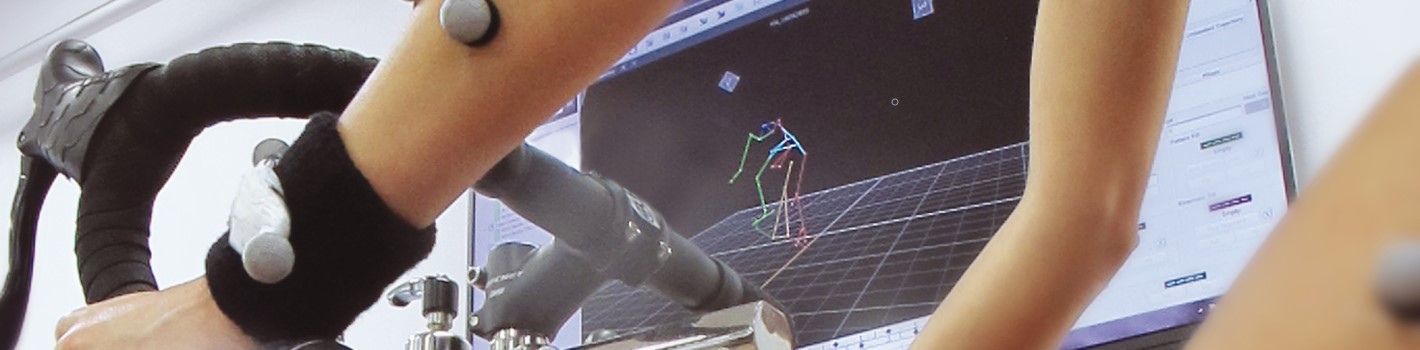
- Functional-biomechanical diagnostics in the field of Sports orthopaedics and traumatology (isokinetic force measurement, pressure and gait analyses, 3D kinematics, stabilometry, EMG)
- Running analysis and insole/ running shoe advice
- Bike and seat position analyses
Typical questions:
- Causes and therapy of Achilles tendon injuries (incl. therapy courses), Functional testing of knee injuries (especially ACL injuries)
- Strength ratios and muscle activity in hip/groin problems and shoulder injuries
- Ankle orthoses: Testing and development, football and running shoe research
The special experience and knowledge of the racecourse clinic
- Holistic concept in close cooperation with doctors and physiotherapy
- Functional search for causes of injuries
- Criteria-based, progressive rehabilitation build-up on the Based on biomechanical testing
You are currently viewing a placeholder content from YouTube. To access the actual content, click the button below. Please note that doing so will share data with third-party providers.
More Information
Sport-specific movement analysis – Breakdance
Breakdance is a young sport and in the breaker scene a lot of the learning of movement is based on the trial and error principle – without ever having a detailed analysis of the movement. And this despite the fact that the movements consist of a sequence of many complex movement elements.
The racecourse clinic therefore launched the «Capture Breakdance» project in cooperation with one of the world’s best B-boys. The biomechanical investigation focused on four power moves (airflares, headspin, flares, ninty niners), as these can often be incorporated and performed repetitively.
The aim was, on the one hand, to quantify the stress in terms of prevention measures, and to determine the core elements of successful exercise.
Thanks to the 3D kinematics data, the movement parts could be viewed in isolation and then specifically trained. The realisation that, for example, the flight phase of an air flare is initiated by hip and shoulder extension can be used as concrete instruction in movement learning. Through kinetics, it was possible to recognise which movements put particularly great strain on the musculoskeletal system. For example, up to almost 2 times the body weight acts on an arm in rotation and, on the other hand, the force vector partly runs outside the joint centre. These high-impact phases could be reduced through modified movement execution, which is very important in terms of injury prevention – but of course always taking into account the style element, which is an important part of this sport.